![[object Object]](/_astro/aglaia-dark.fX8O5LwM.png)
Processors
All processors live in aglaia/processors/. Each has:
- A
*Optiondataclass extendingAbstractProcessorOption(aglaia/processors/abstraction.py). - A class extending
AbstractImageProcessor.
Processor contract (AbstractImageProcessor)
| Member | Required | Purpose |
|---|---|---|
SUMMARY: str | yes (UI-exposed) | One-liner for the add-step menu. |
OPTIONS: dict[str, ParamSpec] | yes (UI-exposed) | Option specs; the registry’s discovery gate. |
REPLAY_TRAIT: ReplayTrait | for replayable steps | COORDINATE / PIXEL_VALUE / ROI — drives the replay engine (see pipeline.md → Replay pass). Also gates per-page disable: only COORDINATE/PIXEL_VALUE steps are toggleable; ROI / branch-emitting steps (e.g. PageDetector) are locked because skipping them would restructure the branch tree. A disabled step is bypassed with a passthrough node (see storage.md). |
process(buffer) -> ImageBuffer | list[ImageBuffer] | None | yes | The transform. Mutate buffer and return it; return a list (or set buffer.children) to branch; return None to stop the branch. |
replay(buffer) | no | End-of-chain reconstruction. Default re-runs process(); geometric processors stamp replay_kind/replay_params so the engine fuses their warp instead. |
OPTION_CLASS | no | Explicit options dataclass; default is synthesised from OPTIONS. |
REGISTRY_NAME | no | Registry key; default is the class name. |
PROVIDES_META: dict[str, str] | no | Documentary declaration of the meta keys this step stamps onto its output buffer (key → meaning), beyond the replay_kind/replay_params plumbing. Lets a downstream processor or plugin author discover what’s available upstream, and feeds the generated reference. Declaring a key does not stamp it — the processor still writes buffer.meta[key] itself. |
The chain calls run(buffer), which wraps process() and enforces the
output-format contract (ImageBuffer, list, or None). __init_subclass__
validates the contract at import (warns on a missing SUMMARY, or OPTIONS
keys with no matching option field).
Common option fields
AbstractProcessorOption contributes only plumbing fields every processor
inherits: debug (bool), debug_dir (str?), timeout_s (float). They are
hidden from the parameter descriptions.
DPIfixer (aglaia/processors/DPIfixer.py)
Clamp ImageBuffer.dpi into [min_dpi, max_dpi] via cv2.resize. INTER_CUBIC for upsampling, INTER_AREA for downsampling. Updates meta["roi"] (point coords scaled). No-op if change <1 dpi.
options: min_dpi: 100 max_dpi: 300Use it both as input clamp (early) and normalize (e.g. force exactly 300dpi by setting both bounds equal).
SkewFinder (aglaia/processors/SkewFinder.py)
Two-pass projection-profile deskew:
- Downscale to 400px tall, then binarize (Otsu) — estimation only; the output buffer is untouched by this downscale.
- Coarse search: ±
max_anglein 1° steps. Score =sum(diff(row_sums)^2)on a sheared copy (rows align when angle matches). - Fine search: ±1° around best angle in
accuracysteps. - If
apply_rotationand|angle| ≥ min_angle, rotate viacv2.warpAffine. Border value = white for color, configurable viak_cluster.
Stored as meta["skew"]. meta["roi"] polygon is transformed by the same matrix.
options: max_angle: 30.0 # Search range in degrees min_angle: 0.1 # Minimum angle to actually apply rotation accuracy: 0.1 # Fine-search step apply_rotation: true k_cluster: 0 # 0 = white background. >1 = k-means cluster count for bg color detectionestimate_skew(image) is a module-level helper used by ImageBuffer.deskew.
LayoutBackend (text detection)
aglaia/processors/layout_backends/ — pluggable abstraction picked via the backend: YAML option on PageDetector.
| Backend | Model | GPU |
|---|---|---|
apple_vision | macOS Vision framework | Neural Engine / GPU automatic |
east | frozen_east_text_detection.pb (~95 MB) in ./model/ or ./models/ | CUDA via cv2.dnn if OpenCV is CUDA-built |
dbnet | PP-OCR det ONNX (v3/v4/v5) in ./model/ or ./models/ | same as above |
heuristic | none | CPU only |
auto | dbnet → apple_vision (macOS only) → east. Raises an error if no model is installed (no heuristic fallback). | inherits |
Each backend reports uses_gpu. The chain stamps meta['gpu'] = True on every node produced by a GPU-backed processor; the web UI then renders a 🚀 next to the step in the per-scan timing bar.
PageDetector (aglaia/processors/PageDetector.py)
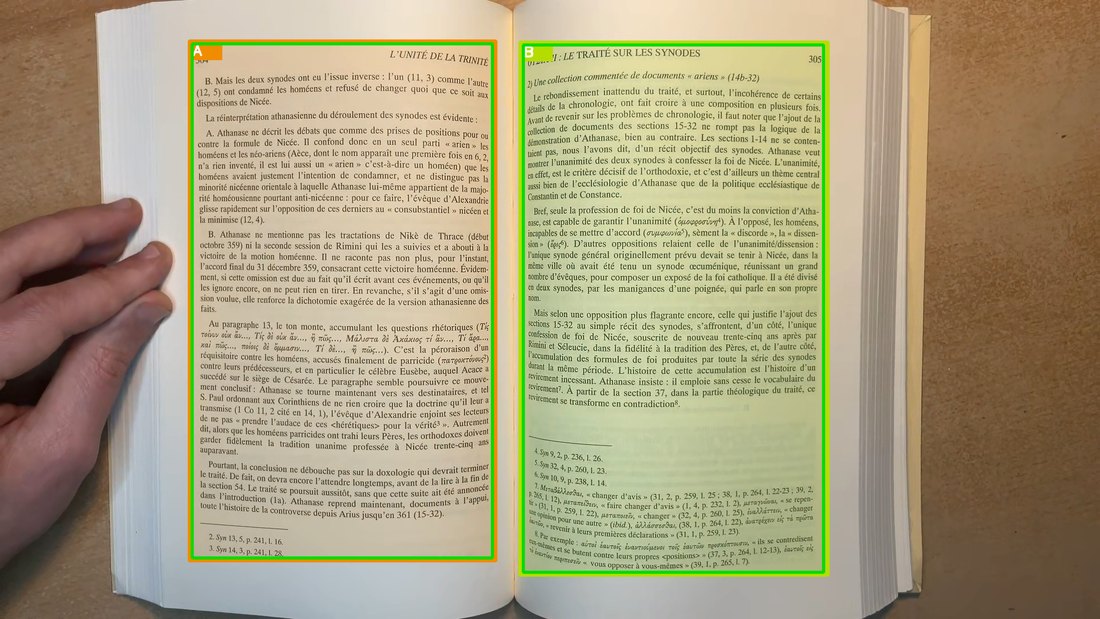
Apple Vision text detection → merge overlapping x-spans → optional reduce-to-N → emit child buffers.
- Optionally downscale to
processing_dpifor detection (defaults to no downscale). - The configured
LayoutBackend(auto→apple_visionon macOS).detect(img)returns bounding boxes. xy_cut(boxes)groups the boxes into columns at vertical whitespace gutters wider thangutter_min_frac.- Contrast filter (
min_contrast): drop a group whose ink range —p95 − p5of the pixels under its detection boxes, relative to the strongest group — falls below the threshold. That is what a bleed-through ghost looks like: pale where its ink is. Measured over the group’s whole bbox instead, as it was until 2026-09, the metric is a density proxy — a sparse layout is mostly paper, sop5lands on paper too and the range collapses however black the ink. It deleted a title page, two chapter openings and two chronology date columns over the 141 spreads of one book, at 0.12–0.35, where the ink measure puts the worst page of that book at 0.68. smart_mergefolds over-split groups back together, scored by themerge_*weights. Ifmax_pages > 0and the count still exceeds it, theover_capstrategy reduces the surplus:"merge"folds the best-scoring pair together (default), while"discard"drops the smallest page. Single-page modes (sheet,book_flat_x1) useover_cap: discardso marginal text bleeding in from a facing page is thrown away rather than merged into the kept page. Genuine over-splits scoring ≥merge_thresholdalways merge regardless of strategy.- Tighten each page horizontally (
tighten_x): walk in from each extreme and stop at the first step below 10% of the page width, so a cable, a hand or the edge of a cup is dropped. On a two-page spread the spine side stands down — it is bounded by the crease instead, taken as the midpoint of the gutter between the two page rects. The gap test cannot tell an intruder from a legitimate element that stands alone, and it was eating text: a lone date in a chronology column, and the two longest lines of a short ragged block (#86). An intruder comes from outside the book, never from the gutter, so the side is the discriminator. Single-page captures have no crease and keep the test on both sides. - Extend each page vertically into a
margin_mmband to pick up a running head above or a page number below the body rect. - For each page, crop the original image with
margin_mmmargin, build a childImageBuffer. Intersect the parent’smeta["roi"]polygon with the child ROI viacv2.intersectConvexConvexand propagate the result. - The child ROI — the region the downstream
BinarizerKEEPS, everything outside it is erased — is the page’s text boxes dilated byroi_margin_mm. Withroi_hull(default) that’s their convex hull; with it off, their axis-aligned bounding rect. Prefer the hull on any capture that isn’t shot square-on: a text block photographed at an angle has its corners well outside the printed area, and that is exactly where the fingers holding the book, or the facing page, appear. Dilation is exact — every box is grown by the pad and the corners re-hulled, which ishull(boxes) ⊕ square(pad)— so no vertex is under-padded and a sharp corner can’t blow up the way a miter offset would. The hull is always a subset of the padded bbox, so turning it on can only tighten the ROI. - Returns
input_buf.children(list of buffers). The chain re-injects each child into the pipeline starting at the next step and prunes the parent file from output.
options: margin_mm: 2.0 # crop margin around each page bbox roi_margin_mm: 4.0 # ROI padding for the Binarizer; raise if margins clip roi_hull: true # ROI = convex hull of the text boxes (false = bbox) max_pages: 2 # 0 = infinity over_cap: merge # over-cap reduction: merge | discard (drop smallest) processing_dpi: 150.0 # null = no downscale rescale_threshold: 0.01 merge_threshold: 0.60 # column-merge score cutoff merge_gap_weight: 0.4 # gap term weight in the merge score merge_width_weight: 0.6 # width-similarity term weight merge_gap_norm_cap: 0.15 # cap on the normalized inter-box gapThe default auto backend resolves dbnet → apple_vision (macOS) → east. The projection-profile heuristic is no longer an auto fallback — auto raises LayoutModelUnavailable if no ML model is installed (download one with aglaia setup or the in-app downloader); pick heuristic explicitly to use it.
Hand-drawn layout set (#118). When manual_overrides carries layouts
on the scan’s TRUNK (branch_path == "") — a list of polygons in
PageDetector’s own input coordinates, with layouts_frame_wh for provenance —
it REPLACES detection for that page. The bboxes become the pages in the order
given, each polygon becomes its child’s ROI verbatim (no text-tightening, no
hull: the user has already said where the page is), and the crop is derived
from the polygon rather than the polygon clamped into the crop. smart_merge
and the max_pages cap are skipped. It is read before the empty-page guard,
so a layout can be added to a page the detector found nothing on, and a layout
deleted by hand is not found again on the next run. A set drawn on a
differently-sized frame is refused and detection resumes, like every other
spatial override. It outranks a per-branch roi, which was drawn on a crop
that may no longer be the same shape.
Erase masks (aglaia/processors/erase.py)
meta["roi"] names the region to keep. meta["erase"] names regions to
drop — a list of polygons in the coordinates of the buffer carrying them.
It is a general facility, not one plugin’s private arrangement: any processor
that can find something the page should not contain (a library stamp, an
owner’s inscription, a barcode label, a finger) says so by appending a polygon,
and the Binarizer consumes them.
Polygons rather than rasters, because the region has to survive the geometry —
deskew rotates, keystone applies a homography, dewarp remaps a curved sheet,
and the mask must arrive at the binarizer sitting exactly where the stamp is.
roi already makes that trip. The rule for carriers is one line: if you
transform roi, transform erase on the same line. A mask left at the old
coordinates erases the wrong part of the page, silently. erase.py provides
transform_affine, transform_perspective, transform_translate,
transform_remap and carry so no carrier has to invent it.
Removing a region without leaving a rim
Painting the stamp white before binarizing is the obvious move and it is wrong twice:
- A hard white patch is a strong local edge. Wolf’s threshold comes from a window’s mean and variance; a window straddling the boundary sees a step and marks a black ring along it — a spurious blob exactly where the user asked for nothing.
- Wolf is globally sensitive to a dark region. Its formula uses the image’s global minimum grey, so a big black stamp shifts thresholds across the whole page. Removing it before binarizing is a statistics exclusion — which is why “exclude from the statistics” and “paint it out” are two halves of one operation, not two competing options.
So the forward pass (fill_with_paper) fills each region with the paper
level measured from a ring just outside it — not white, and not one value
for the page. The Binarizer once had a global bg-fill for the ROI and gave
it up ("interior lighting gradients still produce ink rings" —
_fill_outside_roi_with_bg, now dead code); the lesson is that one paper level
cannot serve a page that is brighter at one edge, and a fill that does not
match its surroundings is the step it was meant to remove. Locally, the ring
value is the paper. The fill extends a halo of at least half a Wolf window
outside the polygon, so a window centred on the edge sees only paper on the
erased side.
After binarizing, whiten fills the polygon pure white with LINE_8 — never
LINE_AA, since an anti-aliased edge is a row of mid-greys and a mid-grey
beside a threshold is a black pixel — grown by erase_grow (default 2, the
mirror of roi_shrink) to take any surviving rim with it.
In replay
Replay carries a keep-mask through every geometric step and binarises once at
the end with wolf_masked, which already skips masked-out pixels when
computing its local statistics and whitens them afterwards. That is exactly
what an erase region needs, and it is better than the forward pass’s fill: a
true exclusion rather than a substitution approximating one. So in replay an
erase region is not painted at all — the producing processor subtracts it from
the keep-mask (erase.punch) at the point in the chain where it was found, and
it rides the geometry to the final binarize for free.
The forward binarize stamps erase into replay_params as provenance
only. Those coordinates are in its own input frame; replay binarises a
differently-sized fused composite, so applying them there would erase the wrong
part of the page.
Who produces one
StampRemover (a registry plugin, processors/stamp-remover) is the first
producer: it matches a library stamp by SIFT against a user-built library and
appends the matched exclusion polygon. It changes no pixels — it finds, and
the host removes. That split is why the plugin is small and why the removal is
correct in replay as well as in the forward pass.
Placement matters and is not a suggestion: an erase producer belongs right
after the layout split, before any geometric step. Replay folds erase regions
into its keep-mask at the anchor, so a producer sitting after a warp has
polygons in the wrong frame by then; _anchor_erase checks the frame and skips
with a note rather than erasing the wrong pixels — meaning a badly-placed
producer works in the forward pass and quietly does nothing on replay.
Binarizer (aglaia/processors/Binarizer.py)
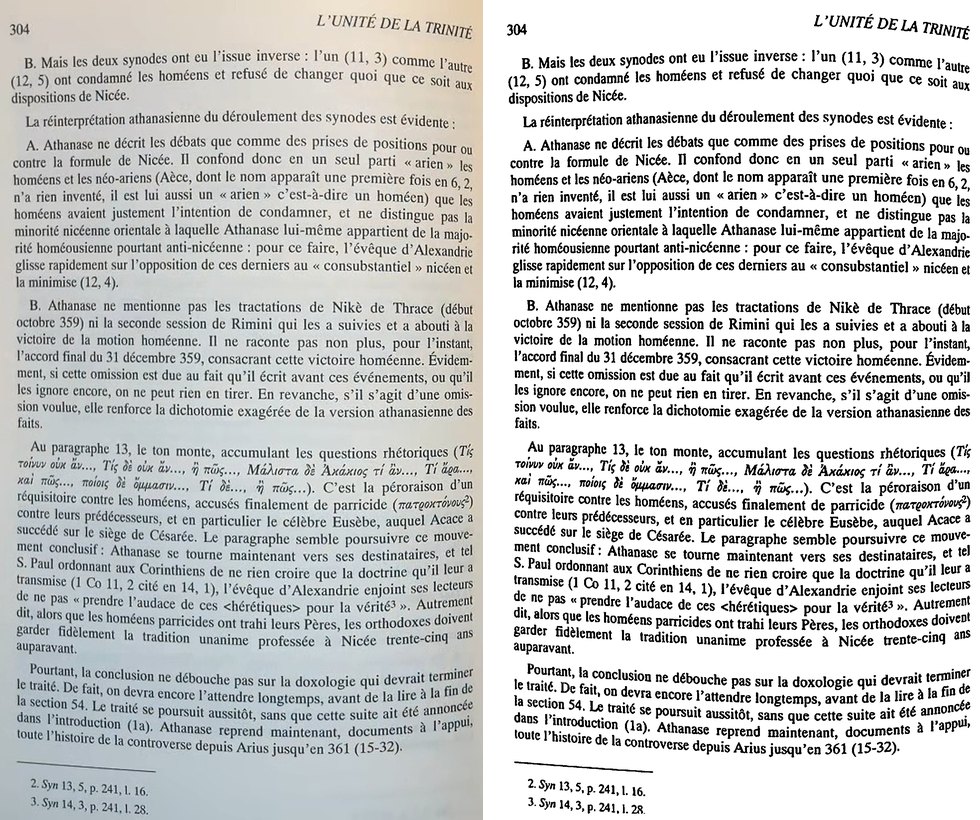
Local adaptive thresholds (Wolf/Sauvola/…) compute a per-window cutoff, so a shadow or lighting gradient across the page doesn’t swallow text the way a single global threshold would.
Dispatcher with four modes:
NONE— pass through.GRAY— convert to grayscale (no thresholding).- DOXA — any algorithm name from
doxapy.Binarization.Algorithms(e.g.WOLF,SAUVOLA,NIBLACK,BERNSEN,BHT,BRADLEY_ROTH,OTSU). Family-specific params (window_mm_<family>,window_px_<family>,k_<family>) go throughdoxapy.Binarization.to_binary(binary, params).
options: method: "wolf++" window_mm_wolf: 3.2 # Wolf window in mm; each family has its own window_mm_<family>/k_<family> k_wolf: 0.5 # Threshold bias for the wolf family roi_shrink: 5 # Erode meta['roi'] mask N×, force out-of-ROI pixels white morpho_close: 2 # Morphological close (0–10) after thresholdwolf vs wolf++
wolf is doxapy’s Wolf over the whole frame, with the page outline wiped
white afterwards.
wolf++ is Wolf that understands missing values, and it is the same
algorithm at both ends of the chain. A pixel inside an erase region — or
outside the page outline — is not thresholded and then painted over: it is
excluded from the local mean and variance and from Wolf’s global minimum
grey, then written white. _wolfpp runs wolf_masked; Binarizer.apply_replay
runs the same function on the same parameters, and the two agree to the pixel
(tests/processors/test_erase_masks.py).
It did not, until #144. The constructor mapped WOLF++ to WOLF for doxapy,
so the forward pass ran plain Wolf and the ++ only engaged at replay: a
user who selected wolf++ got two different algorithms depending on which end
of the chain they looked at. The pre-binarize paper fill existed to paper over
an algorithm that had never been asked to handle the hole — which is why it
grew the region by half a window, and why that halo ate the line of text
beside a stamp (1625 px of real ink, to remove ~25 px of specks).
wolf++ falls through to plain Wolf when there is nothing to be mask-aware
about — no ROI and no erase — because the answer is then identical and doxapy
is three times faster (7 ms vs 23 ms on a 3 Mpx page).
Non-Wolf methods have no notion of a missing value, so an erase region is still filled with the paper tone measured around it before thresholding — with no halo.
ROI masking (_apply_roi_mask): pixels outside meta["roi"] are forced white
after binarization, with roi_shrink erode iterations first. Under wolf++
the outline is already excluded from the statistics, so this is a
belt-and-braces wipe rather than the thing that removes the border artefact.
BW inputs are a no-op (pass-through).
Shared text-scale estimate (aglaia/processors/text_metrics.py)
Both TrapezoidalCorrection and PageDewarper size their line-joining
morphology from the median height of character-like connected components. Each
used to carry its own copy of that estimator; two copies of one estimate drift
apart. Now there is one (median_char_height), and the rule is meta is a
cache, never the only source: the keystone step writes char_h_frac
(dimensionless — median glyph height over the analysis frame height, so it
survives a resample), the dewarper reads it if it is there and computes it
through the same function if it is not. The pipeline works with or without the
keystone step; the two steps agree by construction; the only thing meta buys is
skipping a recomputation. (#143)
TrapezoidalCorrection (aglaia/processors/TrapezoidalCorrection.py)
Keystone (pure perspective) rectification: text-line baselines → vanishing point (RANSAC + TLS) → column quadrilateral → Zhang-He metric aspect recovery → single cv2.warpPerspective.
All detection (binarize, connected components, morphology, span assembly, baselines, quad) runs at processing_dpi (default 150 — same convention as PageDewarper/PageDetector); the 4 quad corners scale back exactly and only the final warp touches the full-res buffer. Stamps replay_kind: "perspective" with the full 3×3 homography for the replay pass.
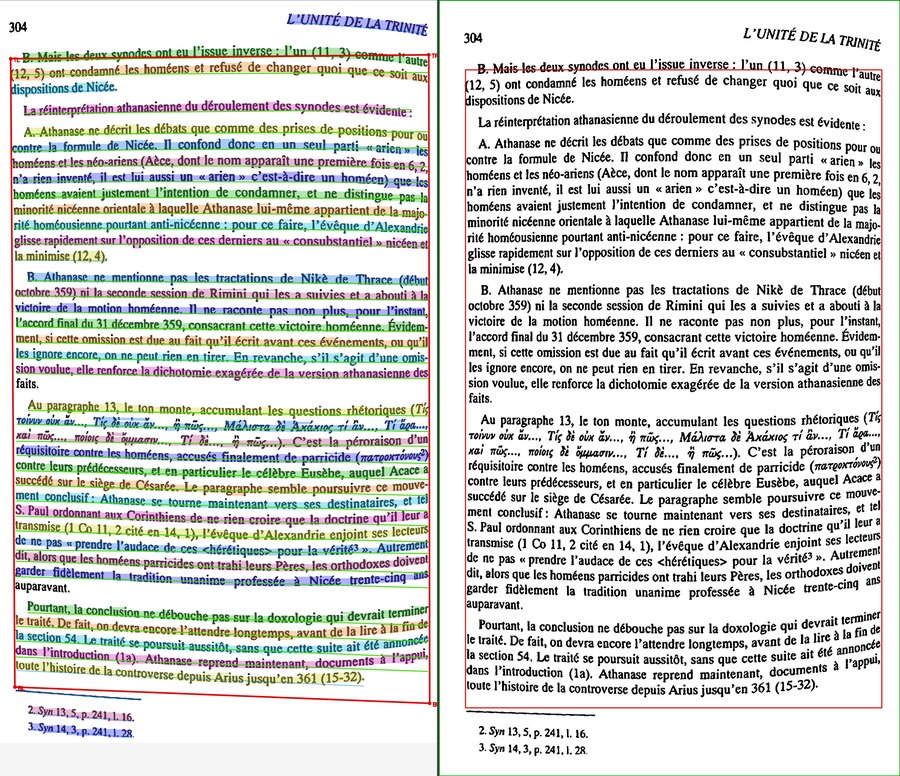
A manual column quad (manual_overrides.quad, M9) replaces the whole detection: the baselines, the vanishing point and the edge clustering are what is being overridden, so none of them runs and the min_line_count guard — which exists to protect that detection — does not apply. The four points arrive in the step’s input coordinates; a non-convex quad is still refused (it has no valid homography and the warp would fold the page over itself), while the area floor is skipped because the size is the user’s call. Both paths land through _rectify, so a corrected page differs from an estimated one by its four corners and nothing else.
options: line_source: connectivity # connectivity | meta (PageDetector boxes) min_line_count: 4 processing_dpi: 150.0 # analysis resolution; final warp is full-res ransac_trials: 200 margin_mm: 2.0 zhang_he_min_skew: 0.05 # skip metric upgrade on near-axis-aligned quadsFalls back to passthrough (Status.REVIEW) when too few baselines or the quad fails convexity/area/aspect sanity checks.
Spine-aware estimation (spine_aware, default off)
Near the binding the page curls out of plane, so the bottom-most ink sits
progressively lower than the true baseline. That is evidence which is
systematically wrong, not merely noisy, and an unweighted fit lets it tilt
the line and drag the vanishing point. Knowing which edge carries the fold —
the page_side meta PageDetector stamps on a spread, which survives this step
since 2026-08 — allows three corrections:
- Curl-zone down-weighting. Column weights ramp from a 0.25 floor at the fold to 1 outside the innermost 30% of page width. The RANSAC inlier band scales with the weight (curl-displaced bottoms fall out more easily), candidates score by weight sum, and the refit is weighted least squares. Measured on a synthetic line, this cuts the curl-induced baseline tilt by 57-69% across sag strengths of 12-30 px.
- Fold-side cluster bandwidth ×2. Only that edge — its endpoints wobble
with the curl and would otherwise splinter into clusters below
min_support. - A well-supported tilt disagreement is kept. With curl-weighted baselines both edges are genuine evidence, so a disagreement backed by ≥ max(6, half the members) on both sides is real keystone convergence, not one side locking onto a slanted minority. When one edge is weak, the fold side arbitrates (curl corrupts it by construction) rather than member count.
spine_aware: false gives the exact side-agnostic behaviour, and the option
is inert on single-page scans (no page_side to resolve).
Off by default, on the corpus evidence. It was briefly enabled and then reverted. On the 12 fixture pages: mean 0.926 → 0.929 px, median 0.879 → 0.897 (worse, ~9× the noise floor), worst page 1.206 → 1.128 (better). More tellingly the per-page benefit correlates +0.275 with page curl — the opposite of the mechanism’s premise, with low-curl pages gaining (−0.024 mean) and high-curl pages losing (+0.031).
It is kept rather than removed because the two measurements genuinely disagree and the direct one is strong: −57 to −69% curl-induced baseline tilt on synthetic sag, plus the iOS port’s device validation on handheld captures. The fixture corpus is rig captures — a different curl regime, and the most plausible reconciliation, though that is a hypothesis rather than something measured here. Turn it on for handheld or strongly-curled material, where the corpus above says nothing useful either way.
PageDewarper (aglaia/processors/PageDewarper.py)
Dewarping removes the curvature + perspective that make a photographed book page look bowed: near the spine the page curves and tilts, so every text line bends into a banana shape a single deskew rotation cannot undo. PageDewarper fits a 3-D sheet model to the detected text baselines and re-projects it flat, recovering straight lines. The chain runs deskew first (cheap global tilt), then dewarp for the residual curvature.
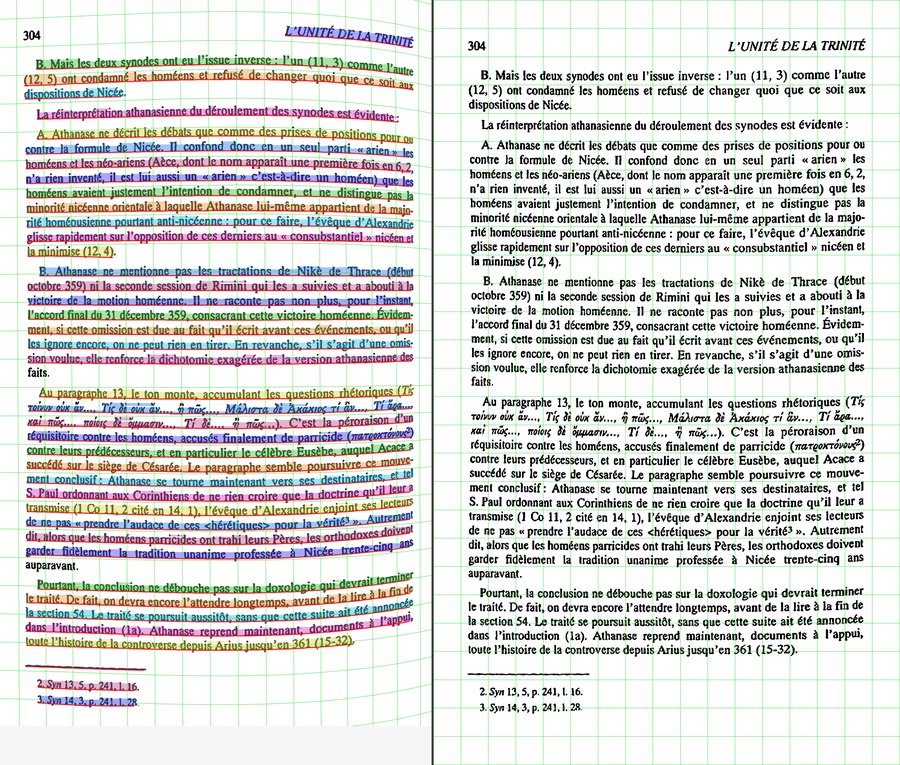
| Deskew | Dewarp | |
|---|---|---|
| Model | single rotation angle | 3-D cylindrical sheet (cubic + spine curl) |
| Fixes | whole-page tilt | curvature and perspective |
| Cost | cheap | optimisation (LM; MLX / JAX / Powell available) |
| When | flat sheets, light skew | bound books, curled pages |
Sheet-model dewarping built on the page-dewarp library. Optimizer backend
(backend: auto) resolves to LM.
Optimizer backends
| backend | what it is | models | notes |
|---|---|---|---|
lm | Levenberg-Marquardt, analytic Jacobians, Schur complement over per-span arrowhead blocks (aglaia/processors/lm_solver.py) | cylindrical | CPU, no GPU pool to babysit. ~10-60 iterations replace Powell’s 10⁴-10⁵ objective evaluations — measured 28 s → 0.25 s per page on the test fixture at a better final objective. The only backend carrying the camera upgrades below. |
mlx | MLX value+grad, Apple Metal | cylindrical | Needs clear_pool() between pages (unified-memory allocator). |
jax | padded JAX L-BFGS-B (fixed shapes, batchable) | cylindrical | Unresolved host-pool growth on Apple silicon; prefer MLX. The CUDA build batches through it. |
powell | SciPy Powell, derivative-free | cylindrical | Reference oracle. Slowest by ~100×. |
The LM problem is bipartite: 8 (or 10) global camera params against S span
heights y_i and N per-keypoint abscissae x_ij. Points in a span share only
y_i, so each local Hessian block is an arrowhead matrix eliminated in
O(nᵢ) by Sherman-Morrison; the Schur complement leaves one n_cam × n_cam
solve per iteration. Env override AGLAIA_DEWARP_LM=0 keeps auto on the
pre-#59 GPU chain.
Camera and objective upgrades (LM only)
Three findings from the iOS port’s on-device debugging (issue #60), all cylindrical + LM only — the MLX/JAX/Powell objectives are the plain centred pinhole, so these options are forced off on those backends:
principal_point(default on) — fit (cx, cy) alongside the pose, camera block 8 → 10. A homography composed with a perspective view of a curled page is a general projective camera; the centred square-pixel pinhole cannot represent it, which is why the fit under-curls near the spine afterTrapezoidalCorrection. Measured on the fixture page: output line curvature 1.77 → 0.98 px.spine_weight_boost/spine_weight_zone(default 4 over the spine-side 25%) — the binding-side tail is a least-squares minority, so an unweighted fit systematically under-curls there (2-4 px at 300 dpi). Weights ramp fromboostAT the binding to 1 at the far edge of the zone. Needs a resolvable binding side (seebinding_side); off otherwise.spine_gammas/spine_gamma_scale— grid search over a spine-localized directrix termz += γ·exp(−|x − x_binding| / s), each candidate fitted and the best objective kept. γ = 0 (the plain cubic) always competes, so the grid can only improve the fit. Only identifiable with the principal point — under the 8-param camera the composed-camera offset is absorbed into curl and masks the basis term. Also fixes horizontal compression at the fold: output x-scale comes solely from ∫√(1+z′²)dx, so an under-sloped surface under-allocates arc length exactly there. Both signs of each γ are tried (the physical curl direction is not fixed across corpora).
binding_side: auto reads the page_side meta the PageDetector stamps on
two-page spreads; single-page scans need it set explicitly or the spine
features stay off for that page. That meta has to survive the intervening
steps — TrapezoidalCorrection returns a fresh ImageBuffer and dropped it
until 2026-08, which silently disabled the spine features and
flat_spline’s binding-side flip/penalty and the per-side warm-start ring
for every page in the default pipeline. Anything added to that path must
forward _CARRIED_META.
Measured on book_curved_x2 over the full fixture corpus (test_athanase,
test_augustin, test_balthasar — 6 spreads → 12 pages), mean deviation of
the output text baselines from a straight line:
| sheet model | solver | mean | worst page | ms/page |
|---|---|---|---|---|
| cylindrical + spine curl | LM, 10-param | 0.923 px | 1.194 | 659 |
| cylindrical (γ off) | LM, 10-param | 0.960 px | 1.345 | 236 |
| flat_spline | MLX | 1.679 px | 3.315 | 553 |
| bspline_twist | MLX | 1.648 px | 3.053 | 635 |
| sine_twist | MLX | 1.645 px | 3.051 | 681 |
Measured with slope_emphasis: 0; the shipped default of 1 scores 0.926 px,
inside the noise floor (that option changes horizontal scale, which this
vertical metric cannot see — see below).
The cylindrical + spine-curl model wins on every one of the 12 pages. Most of that margin is the LM solver and the principal point (an 8-param Powell fit of the same model scores 2.04 px); the γ term itself adds a further ~4% on the mean and ~11% on the worst page, for ~3× the fit time (the grid is 6 extra LM fits). The twist family never wins on any page.
Slope-based x decompression (slope_emphasis, default 0)
The arc-length grid corrects the surface-length term: paper is inextensible, so sampling uniformly in x stretches text by √(1+z′²) where the sheet is steep. It does not correct projective foreshortening — where the page recedes steeply near the spine the camera sees those glyphs compressed however the surface is parameterised, and arc length alone gives them no extra output pixels.
slope_emphasis (k) weights the grid measure by (1 + z′²)^(k/2), so steep
regions claim proportionally more output width. z′ is recovered per segment
from the measure itself (ds/dx = √(1+z′²)), so it needs no model derivative.
k = 0 reproduces the arc-length grid exactly — the path every
already-stamped project replays through — and the value is carried in the
replay stamp so a replayed page is sized like the live one.
When it matters. The weight is (1 + z′²)^(k/2), so the effect scales
with the square of the sheet slope — negligible on a mildly curled page,
substantial on a strongly curled one. Measured at k = 1 (output width, and the
share of output columns landing in the steepest quarter of page-x):
| max |z′| | width k=0 → k=1 | steep-quarter share |
|---|---|---|
| 0.10 | +0.3% | 0.251 → 0.251 |
| 0.25 | +0.5% | 0.252 → 0.253 |
| 0.50 | +1.5% | 0.256 → 0.262 |
| 1.67 | +16.9% | 0.318 → 0.403 |
Default k = 1, matching the iOS port, where it is device-validated on real
captures. Be clear about what backs that: it is device validation there plus
the maintainer’s judgement on his own scans — not a local measurement. The
A/B harness scores baseline straightness, a vertical property, and this
changes only horizontal scale, so the harness is structurally blind to it. What
the harness can say is that it does not regress: k = 1 over the corpus scores
0.926 px against k = 0’s 0.923, at the run-to-run noise floor (~0.002 px, see
docs/development.md). The fixture corpus also fits mild curl, where the table
above puts the effect under 1% — so a null result there is what the mechanism
predicts, not evidence either way.
Set slope_emphasis: 0 to recover the exact pre-#70 arc-length geometry.
Projects stamped before this option carry no key and replay at 0 regardless of
the current default — they render exactly as they were fitted.
Failure ladder
A fit is judged by the max_oob gate on its remap, not by its objective — the
objective cannot see a wild remap. On one fixture page γ = −0.10 (the grid
edge) scored below γ = 0 while overshooting the gate. A rejected fit walks
down, cheapest rung first:
| rung | what | cost | why it can fail |
|---|---|---|---|
| 1 | LM fit, γ grid searched | ~660 ms | the γ grid can select a wild surface |
| 2 | diverged page_dims → rough dims, let the gate judge | free | — |
| 3 | re-fit with the γ grid off (plain cubic) | ~125 ms | the curl itself can run away |
| 4 | re-fit with the curl frozen at 0 — pose and page dims around a flat sheet | ~6 ms | cannot: a zero-curl surface has no runaway remap |
| 5 | grayscale passthrough, Status.ERROR | — | — |
Rung 4 gives a page that is perspective- and pose-corrected but not curl-corrected — worse than a good fit, much better than a grey one. It is also the only rung that answers the other documented failure: LM parking a shape DOF on the ±0.5 curl clamp at a competitive objective but a wild remap. It is dormant on healthy pages (0 firings across the 12-page corpus) and its result is deliberately not recorded in the warm-start ring — a curl of 0 by construction is not a measurement, and seeding the next page with it would propagate one page’s failure.
LM with the plain 8-param camera is not uniformly better than Powell,
even though it reaches an equal-or-better objective.
The objective has a near-flat curl/pose valley and LM occasionally parks a
shape DOF ON the ±0.5 curl clamp — same objective as the sane region, wild
remap (reproduced here: α = −0.503 on one page). The principal-point DOF
removes the degeneracy, which is why it is on by default. If you turn
principal_point off, expect the pre-#60 quality band, not the numbers above.
The iOS port retries a rejected fit on Powell, which is right where Powell costs ~540 ms. On the desktop it is 25-80 s per page — 200× the γ back-off for the same recovery — and until #64 the chain dropped a page whose step outlived the run, so the Powell retry lost the very page it was meant to save. Rungs 3 and 4 are the desktop equivalent, at 125 ms and 6 ms.
The sheet model
One model: the cylindrical sheet z(x) = (α+β)x³ − (2α+β)x² + αx — a
generalised cylinder, every horizontal slice sharing one height profile — plus
the optional spine-curl term above.
The twist/spline family (sine_twist, bspline_twist, flat_spline:
Fourier-sine and clamped cubic B-spline profiles modulated by a linear-in-y
twist gain) was retired in 2026-08. They were strictly more expressive on
parameter count and strictly worse on results — see the table below, where the
cylindrical + spine-curl model wins on every page. A fold concentrates
curvature at the spine, which one localized term captures robustly, while the
global spline families spread degrees of freedom where there is no curvature,
overfit noisy spans more easily, and are harder to optimise.
This is a hard break: a .agl node stamped with one of those models raises
on replay (sheet_models.canonical_model) rather than being rebuilt against a
different surface — re-process such a page from source. Do not reintroduce them
without beating 0.923 px on the same corpus.
Pipeline:
- Pad input by
dewarp_marginmm with white border. - Downscale to
processing_dpi(default 150) for span analysis; the remap reads full-res pixels. - Build a text mask (mm-sized MORPH_CLOSE, char-scale adaptive); assemble spans; fall back to line-mask morphology if <3 text spans.
- Sample span curves via robust span-level fits (
fit_span_baseline: IRLS Tukey cubic over each text line’s ink profile — descenders/dashes rejected by the loss, keypoints reach line ends).baseline_sourceselects what feeds the model:bottom(baselines),top(x-height toplines),average(midlines), orboth(default — baseline + topline as separate spans, doubling vertical constraints). Toplines are validated to sit 0.3–2.5 x-heights above the baseline. - Optimize the sheet + per-span/per-point coords. With
use_huber(default on) the reprojection loss is pseudo-Huber (huber_delta, normalized units) on the LM (via IRLS — the Gauss-Newton weight1/√(1+r²/δ²)recomputed each Jacobian pass) and MLX/padded-JAX backends — stray spans (footers, captions) can’t drag the sheet.cubic_costregularizes the shape params against phantom curl on flat input (α/β L2 for cylindrical; bending energy for the twist models: Σ(k²c_k)² for sine_twist, second differences of the control polygon for bspline_twist — γ unpenalised). The whole geometry path (solvePnP init, optimise, page dims, remap) runs under the configuredfocal_length. - Remap with an arc-length-uniform x grid (
sheet_models.arclength_x, mid-row profile): output width sized from the sheet’s arc length, so text near the steep gutter side keeps its true width instead of stretching by √(1+z′²). One function builds that grid —PageDewarper._sample_grid, shared by the live remap, by replay (_replay_sample_map) and by the debug overlay (storage/debug_renderers.dewarp_grid_lattice), so all three describe the same surface. Replay params carrypage_dims/focal_length/zoom/decimate/pad_px/src_shape/slope_emphasis, pluscamera_np(8, or 10 when pvec[8:10] is the fitted principal point) andspine(the winningSpineCurl, or null). Those last two are load-bearing: the sampling grid derives from them, so a consumer that ignores either draws — or remaps — a different sheet. Pre-#60 stamps carry neither and default to the 8-param pinhole with no spine term, exactly the surface they were fitted on. - Output size comes from
page_dims, which lives innorm2pixunits — scale0.5 · max(h, w)of the padded input. So the output height is measured against the longer reference side, never againstref_h: upstream page-dewarp usedimg.shape[0]there, which is the same number only on a portrait crop. On a landscape one (a chapter opening, a part-title, any short page whose text block is wider than tall) that scaled the whole remap byref_h / ref_wwhile the node stayed stamped 300 dpi — a 1289×533 page landed at 520×224. Portrait crops are unaffected, so already-stamped projects replay to the size they have today. - Sanity check: if remap goes out of bounds by more than
max_oobpx, abandon dewarp and return grayscale of padded input (Status.ERROR). Span-count guard (min_spans) passes through withStatus.WARNINGinstead of running an under-constrained fit.manual_overrides.force(M9) runs past both. They are right by default and sometimes wrong — a sparse page whose few spans are perfectly good, a wide fit the gate reads as runaway. Forcing is per page, never a default, and stamped (manual: force, plusoob_forcedwhen the gate was the thing overridden) so a bad page stays explainable.
options: backend: auto # auto | lm | mlx | jax | powell principal_point: true # LM: fit (cx, cy) — the keystone-composed camera spine_weight_boost: 4.0 # LM: residual weight at the binding (1 = off) spine_weight_zone: 0.25 # LM: width of the up-weighted spine zone spine_gammas: 0.02, 0.05, 0.10 # LM: spine-curl γ grid ("" = off) spine_gamma_scale: 0.15 # LM: spine-curl decay length, fraction of page width binding_side: auto # LM spine features: auto | left | right baseline_source: both # bottom | top | average | both use_huber: true # robust pseudo-Huber reprojection loss huber_delta: 0.005 # pseudo-Huber scale (when use_huber) max_oob: 400.0 page_margin_mm: 5.0 dewarp_margin: 5.0 remap_decimate: 4 shear_cost: 40.0 cubic_cost: 0.0 # shape regularizer (α/β or spline bending); 0 = off focal_length: 1.3 # Overridden by camera calibration if loaded processing_dpi: 150.0 # Span analysis downscale min_spans: 3 min_span_width_ratio: 0.5 # drop partial-width spans (footers, page numbers) kernel_char_mult: 2.0 thickness_char_mult: 3.0 edge_max_length_char_mult: 3.0 line_join_mm: 4.0 # fallback kernel when char scale unknownWhen debug: true or --debug, writes intermediate visualizations to <workspace>/debug/:
<stem>_0_spans.jpg— colored span overlays.<stem>_1_initial.jpg— keypoint projection from initial params (side-by-side with input).<stem>_2_optimized.jpg— initial vs. optimized keypoint projection.
JAX cache lives at ./.jax_cache/ (auto-created). Persisting compilation across runs saves ~5s startup.
MarginSetter (aglaia/processors/MarginSetter.py)
The last step of every shipped pipeline (output_margin). It crops to the
ink content, then pads a white border — so the margin is measured from the
text, not from whatever canvas the previous step left behind. margin_mm
takes a CSS-style shorthand ("2" all round, "2 6" V H, "2 6 3 4" L R T B);
margin_px overrides it in pixels. All four shipped pipelines ask for 2 mm,
which is also the bare default.
width_floor (advanced, off) pads the page back out to the step’s input
width when the crop came out narrower. Physically the floor is defensible —
flattening a curved page can only grow its width, and an earlier fix for that
up-scaled the image and squished glyphs — but the promise is about page
width, while this step’s contract is content-crop plus a stated margin.
Horizontally it therefore re-adds exactly the whitespace the crop removed, and
the margin stops being the one you set: over 40 real pages asking for 5 mm,
top and bottom came out exactly 5.0 mm while left and right ranged 10.2-16.8 mm
and varied page to page (#112). Turn it on only when every page must stay at
least as wide as the dewarp made it.
The forward pass stamps min_width_px (0 = no floor) so apply_replay
reproduces it exactly; a chain stamped before the option existed carries the
old unconditional value and still replays as it ran.
Note the ROI margins never reach the output: because this step crops to ink,
PageDetector.roi_margin_mm and the hull ROI govern what the Binarizer keeps,
not what the final page measures.
Apple Vision detection (aglaia/processors/layout_backends/apple_vision.py)
AppleVisionBackend is the apple_vision LayoutBackend used by
PageDetector for text-box detection:
detect(img_rgb)— returns the list of bounding boxes (no text).
It uses VNRecognizeTextRequest with RecognitionLevelAccurate and language
correction disabled, wrapped in objc.autorelease_pool to keep memory bounded.
Text recognition for OCR is a separate concern — the apple_vision /
apple_docs OCR engines live under aglaia/workers/ocr/ (see OCR).
Writing a new processor
- Add a file in
aglaia/processors/. - Define an option dataclass:
from dataclasses import dataclassfrom aglaia.processors.abstraction import AbstractProcessorOption, AbstractImageProcessorfrom aglaia.ImageBuffer import ImageBuffer
@dataclassclass MyOption(AbstractProcessorOption): threshold: int = 42- Define the processor:
from aglaia.processors.abstraction import ReplayTraitfrom aglaia.processors.option_specs import _i
class MyProcessor(AbstractImageProcessor): name: str = "MyProcessor" SUMMARY = "One-line description for the add-step menu." OPTIONS = {"threshold": _i(42, 0, 255, "Threshold value.")} OPTION_CLASS = MyOption REPLAY_TRAIT = ReplayTrait.PIXEL_VALUE # omit if the step isn't replayable def __init__(self, options: MyOption): super().__init__(options) self.threshold = options.threshold def process(self, buf: ImageBuffer) -> ImageBuffer: # mutate buf.buffer / buf.meta / set buf.children return buf-
Nothing to register.
aglaia/processors/registry.pyauto-discovers the class on first access — it scansaglaia/processors/*.pyforAbstractImageProcessorsubclasses that declareOPTIONS. The GUI add-step menu, the pipeline loader (Initializer), and the worker chain (IntegratedProcessingChain) all read through the registry; noOPTION_MAP/PROCESSOR_REGISTRYedits, noif name == "X"branches. (To extend without touching the repo, drop the file in<APP_DATA>/plugins/processors/and approve it in the trust prompt.) -
Reference it in a pipeline YAML by its registered name —
REGISTRY_NAMEif set, else the class name (case-sensitive).
Return semantics:
- Return the same buffer → chain continues with that buffer.
- Set
buffer.children = [child1, child2, ...](or return a list) → chain branches; each child re-enters at the next step. - Return
None→ branch stops, warning logged.
User plugins (no repo edit)
Users add processors (and OCR engines) without modifying the repo, in either of two shapes. Both end up in the same registry and the same trust ledger.
Installed from the store — the normal path. Lands as a directory with a manifest naming its entry module:
<APP_DATA>/plugins/processors/<slug>/aglaia-plugin.toml<APP_DATA>/plugins/processors/<slug>/<entry>.pyDropped in by hand — a loose module, for a one-off you wrote yourself:
<APP_DATA>/plugins/processors/ AbstractImageProcessor subclass (SUMMARY + OPTIONS)<APP_DATA>/plugins/ocr/ OcrEngine subclass decorated @registerA store-installed processor gets a PluginContext
self.ctx — settings, secrets, its own data_dir, a log line — exactly as a
destination does. Use it for anything the plugin needs to keep: a model, a
cache, a library of reference images.
It is a lazy class property, not a value fixed at registration, because
processors are constructed inside spawned workers from a pickled
ChainElement; a context built in the parent would never arrive. Each process
that asks builds its own, which is also what SQLite wants.
A hand-dropped loose module gets ctx is None. It never declared a manifest,
so it never declared it wanted settings or secrets — and there is no slug to
namespace them under. A plugin that needs a context needs a manifest.
(<APP_DATA> = aglaia/app_data.plugins_dir(); on macOS
~/Library/Application Support/Aglaia/plugins/….)
Trust gate. Code is not run blindly. At GUI startup
aglaia/gui/plugin_trust.py (wired in aglaia/app.py:_qt_app) shows a warning
for every file that is new or whose content changed since it was
accepted, offering Add / Delete / Skip. Accepted files are recorded
in the plugins table of aglaia-config.db with a sha256.
Invariant — import == code execution. Discovery
(aglaia.app_data.plugins.import_accepted(), called by the processor
registry and aglaia/workers/ocr/__init__.py) imports only accepted,
sha-matching files; an unacknowledged or modified file is never imported.
Plugin dirs are placed on sys.path so a plugin’s module name resolves
identically inside spawned pipeline workers (spawn re-imports by name).
Headless/CLI has no popup — it loads only already-accepted plugins and prints a “pending” warning for the rest. Acknowledge them once via the GUI.
Threat model: stop a user from blindly running a file he dropped (or that something dropped for him). It is not a defense against an attacker with write access to the data dir — hence no signing.
Worked example. examples/plugins/processors/ExemplePluginDespeckler.py
is a complete, heavily-commented drop-in processor shipped for reference. It
demonstrates the whole contract in one file: declaring OPTIONS /
OPTION_CLASS, consuming upstream metadata (meta["char_h_frac"]),
joining the replay pass as a PIXEL_VALUE step via apply_replay(), and
declaring PROVIDES_META. Copy it into <APP_DATA>/plugins/processors/
and accept it in the trust prompt to try it live.
Shared cross-step metadata: char_h_frac
TrapezoidalCorrection and PageDewarper both estimate the median glyph
height while detecting text lines. They stamp it as
meta["char_h_frac"] — glyph height ÷ page height, dimensionless, so it
survives any later resample/warp (a consumer multiplies by its own image
height to get pixels). Absent if fewer than ~30 char-like components were
found. This is the canonical “text scale” hint for downstream steps (e.g. a
despeckler sizing its speckle threshold) that would otherwise recompute it.